

Custom Arcade Cabinet Canada: The 2026 Buyer's Guide
Table of Contents
- Why Buy a Custom Arcade Cabinet Instead of a Pre-Built One?
- What to Look for in the Best Custom Arcade Builders Canada Offers
- Retro Gaming Cabinet Components: What Actually Matters
- Cabinet Styles: Full-Size, Pedestal, and Bartop Options
- Arcade Cabinet Shipping Costs in Canada: What to Expect
- DIY vs. Pre-Built: A Cost and Effort Reality Check
- Space Planning, Electrical Safety, and Maintenance Basics
- Conclusion: Start Your Custom Arcade Cabinet Order
- Frequently Asked Questions
Last Updated: September 8, 2026
Why Buy a Custom Arcade Cabinet Instead of a Pre-Built One?
A custom arcade cabinet is built to your exact specifications, dimensions, control layout, artwork, and game library, rather than a mass-produced unit. The difference comes down to longevity, serviceability, and fit. At Retro Active Arcade, we've spent over 16 years crafting these machines in Edmonton, and the most common regret we hear from buyers is waiting too long before going custom.
Pre-built cabinets often use thinner particle board, generic joysticks, and screens that struggle in bright rooms. A custom build uses commercial-grade components that hold up to daily use, and is designed around your room's dimensions and preferred games. You also get a warranty and a real person to call when something needs adjusting, peace of mind absent with most imported units, which often arrive with no local support.
What to Look for in the Best Custom Arcade Builders Canada Offers
Finding the best custom arcade builders Canada has means evaluating more than price. Check whether the builder actually manufactures cabinets or resells imported units. A true manufacturer will discuss materials, component brands, and assembly openly.
Review warranty terms carefully. A 3-year warranty with lifetime support signals confidence. Ask what it covers: joysticks, monitors, wiring, and labor can all fail differently. Look for modular design with plug-and-play components so you can swap a faulty part without a technician. Finally, confirm the builder handles nationwide shipping with proper packaging, because a great cabinet that arrives damaged helps no one.
Retro Gaming Cabinet Components: What Actually Matters
Retro gaming cabinet components determine how authentic and durable your machine feels, and this is where cheaper cabinets cut corners. Here is what to scrutinize before you commit.
Control Panel: Joysticks, Buttons, and Switches
The control panel is the heart of the experience. The most common joystick in commercial and high-end home cabinets is the microswitch joystick. A quality one, like those from Sanwa or Happ, gives crisp directional input with a distinct click. Cheaper rubber-dome or leaf-switch alternatives feel mushy and register missed inputs during fast fighting games.
Push buttons matter equally. Commercial-grade buttons use microswitches rated for 1 million+ actuations, while consumer-grade rubber wears out within months. Reputable builders often offer Sanwa OBSF-30 buttons (30mm) for fighting games and Happ-style concave buttons for classics like Pac-Man or Donkey Kong.
Monitor: Resolution, Refresh Rate, and Input Lag
The monitor is where many pre-built cabinets fail. A true arcade cabinet should render classic games at native resolution or use a high-quality upscaler. Key specifications:
- Resolution: 1080p is standard, but 4K panels are increasingly common for modern multi-game setups. For retro titles, a 1080p panel with a good upscaler often looks better than a 4K panel with poor scaling.
- Refresh rate: 60Hz is the baseline for arcade games. If you plan to play modern fighting games or shooters, look for a 120Hz panel to reduce motion blur.
- Input lag: This is the most overlooked spec. A monitor with high input lag (over 20ms) makes games feel unresponsive (ieee.org). Ask the builder for the panel's input lag rating; quality panels for arcade use typically stay under 10ms.
Audio: Amplifiers and Speakers
Most buyers ignore audio, but it is half the experience. A single 3-inch speaker will not reproduce the bass-heavy soundtracks of Street Fighter II or Mortal Kombat. Look for at least a 10-watt amplifier and dual 4-inch or larger speakers, and ask whether the system supports stereo separation for directional audio cues.
Modular Design: The Long-Term Cost Saver
A modular design saves you money over time by letting you perform maintenance yourself. Look for:
- Plug-and-play wiring harnesses that connect the control panel to the main board with a single connector, not soldered joints.
- Standardized power supplies (ATX or Mean Well) that you can replace at any electronics retailer.
- Tool-free access panels for the monitor and control deck.
A modular cabinet lets you swap a faulty joystick in under 10 minutes with a screwdriver. A non-modular one may require desoldering or shipping the unit back, the difference between a machine that lasts decades and one that becomes a costly paperweight.
The Unique Angle: Component Certification and Canadian Climate
One angle most competitors miss is how components behave in Canadian conditions. Basement game rooms face humidity swings that corrode cheap wiring. Ask whether internal wiring uses gold-plated connectors (which resist corrosion) or tin-plated ones. Also confirm the power supply is rated for the 120V/60Hz Canadian standard and carries a CSA or cUL mark (canada.ca). Imported cabinets sometimes ship with 220V supplies or uncertified adapters, a safety hazard and potential insurance issue.
A Practical Checklist for Component Quality
Before you order, ask the builder for written confirmation on these points:
- Joystick brand and switch type (e.g., Sanwa JLF-TP-8YT with microswitches).
- Button brand and actuation rating (e.g., Sanwa OBSF-30, rated for 1 million presses).
- Monitor brand, resolution, refresh rate, and input lag rating.
- Power supply brand and certification (CSA or cUL).
- Wiring connector type (gold-plated vs. tin-plated).
- Speaker wattage and configuration (stereo vs. mono).
A builder who answers specifically is building a machine that will perform; one who deflects is likely hiding compromises.
Cabinet Styles: Full-Size, Pedestal, and Bartop Options
Choosing between full-size, pedestal, or bartop is driven by room dimensions, ceiling height, player demographics, and intended use. Here is the practical breakdown.
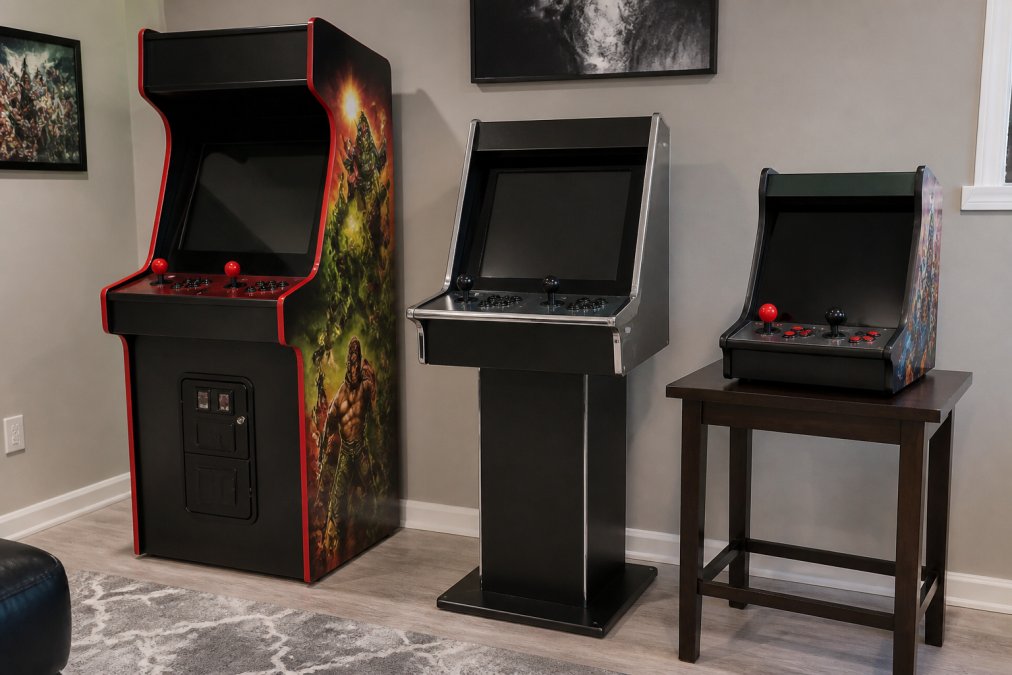
Full-Size Upright Cabinets
A full-size upright delivers the authentic arcade experience with a coin door and controls at standing height. Standard uprights range from 5'8" to 6'2" tall, 24 to 30 inches wide, and 32 to 38 inches deep, with control panel height between 36 and 40 inches, comfortable for players between 5'4" and 6'0".
Space requirements: You need a minimum footprint of roughly 3 feet by 3 feet, plus at least 3 feet behind the control panel for players and another 6 inches for ventilation if against a wall. With a basement ceiling under 7 feet, a full-size cabinet may not fit through doorways or under ductwork.
Ergonomic considerations: Full-size cabinets suit standing play; children under 10 may find them uncomfortable unless the builder offers an adjustable control deck. For commercial spaces, they draw attention and create a focal point but consume the most floor space per player.
Pedestal Cabinets
A pedestal cabinet pairs a compact control deck with a wall-mounted or freestanding large screen. The pedestal is typically 24 to 30 inches wide, 24 to 30 inches deep, and 40 to 44 inches tall, with the control surface at 36 to 40 inches.
Space requirements: The pedestal footprint is small, but the screen changes everything. A 55-inch screen requires 6 to 8 feet of viewing distance; a 65-inch screen needs 8 to 10 feet (smpte.org). You are trading a tall cabinet for a wide viewing area, measure the distance from the control deck to the screen wall before committing.
Ergonomic considerations: Pedestals are the best option for seated play. With a stool, the control deck should be 28 to 30 inches high; some pedestals offer adjustable decks for both standing and seated players. This makes them ideal for corporate offices, accessible game rooms, or venues where players may want to sit.
Screen mounting: A wall-mounted screen requires a VESA-compliant mount rated for its weight, a 55-inch LED screen weighs roughly 30 to 40 pounds, so a mount rated for at least 75 pounds provides a safety margin. Ask whether the screen is included or if you supply your own.
Bartop Cabinets
A bartop cabinet sits on a table or counter, offering the most compact footprint. Typical dimensions are 18 to 24 inches wide, 16 to 20 inches deep, and 18 to 24 inches tall. The screen is usually 17 to 24 inches diagonally.
Space requirements: The cabinet is small, but the surface must be sturdy. A table at 28 to 30 inches works for seated play; a bar counter at 40 to 42 inches works for standing. The surface must support the cabinet's 40 to 60 pounds plus the force of players leaning on the controls.
Ergonomic considerations: Bartop cabinets are the hardest to get right. At bar height, the control deck sits at roughly 58 to 62 inches, suiting players between 5'8" and 6'2"; shorter players will strain their shoulders. For seated play, the screen is often too low. Bartops work best for standing players at a bar or counter.
The Unique Angle: A Decision Matrix Based on Your Space
Here is a practical decision framework based on your room's dimensions:
| Your Room Situation | Recommended Style | Why |
|---|---|---|
| Dedicated game room, 8-foot ceilings, at least 6x6 feet of open floor | Full-size upright | Authentic experience, best for standing play, becomes a focal point |
| Multi-purpose room, wall space available, 6-10 feet of viewing distance | Pedestal with wall-mounted screen | Saves floor footprint, supports seated play, modern look |
| Apartment, office waiting area, or bar with limited floor space | Bartop on a sturdy counter | Compact, portable, fits in small footprints |
| Basement with low ceilings (under 7 feet) | Pedestal or bartop | Full-size cabinets may not fit under ductwork or doorways |
| Primary players are children under 12 | Bartop on a low table or pedestal with adjustable deck | Full-size controls sit too high for comfortable play |
Measuring Your Space Before You Order
Before ordering, take these measurements and share them with the builder:
- Floor footprint: Length and width of the area where the cabinet will sit.
- Ceiling height: From floor to the lowest obstruction (ductwork, light fixtures).
- Doorway width: The narrowest door the cabinet must pass through. Full-size cabinets often require removing doors or angling through hallways.
- Clearance behind the control panel: At least 3 feet for standing players.
- Viewing distance: For pedestal setups, the distance from the control deck to the screen wall.
Ergonomics for Mixed-Height Households
If players range from children to tall adults, consider:
- Adjustable control decks: Some builders offer decks that raise or lower by 4-6 inches. This adds cost but solves the ergonomic problem.
- Step stools: A simple solution for children at full-size cabinets, but ensure the stool is stable and non-slip.
- Seated play: A pedestal with a stool is the most flexible option for mixed heights because the stool height can be adjusted independently of the cabinet.
A cabinet that fits the space and suits its players will get far more use than one chosen purely on appearance. Take the measurements, use the decision matrix, and order with confidence.
Arcade Cabinet Shipping Costs in Canada: What to Expect
Arcade cabinet shipping costs Canada buyers face vary by size, weight, and delivery distance. A full-size cabinet requires freight shipping, protective crating, and a liftgate for curbside delivery; bartops ship more economically.
When comparing quotes, ask what the price includes. Some builders add fuel surcharges, residential delivery fees, or inside-delivery charges. Others offer free shipping to your door anywhere in Canada, removing a significant budget variable. Always confirm how the delivery process handles damage risk. Ask what happens if the cabinet arrives damaged before you sign for it, that answer protects your investment.
DIY vs. Pre-Built: A Cost and Effort Reality Check
Building your own cabinet can save on materials, but costs add up quickly with quality plywood, a commercial-grade control panel, a proper monitor, an emulation setup, and cabinet art. The time investment is substantial: planning, cutting, wiring, and troubleshooting can consume dozens of weekends.
A common mistake is underestimating finishing work. Painting or applying vinyl wrap, installing T-molding, and aligning the control panel require patience and precision, many DIY builders finish the electronics only to spend weeks on aesthetics.
Pre-built cabinets shift that effort to professionals. You pay for their expertise, but you gain a machine that works on arrival, is covered by a warranty, and comes with support. For most buyers, the premium is worth the certainty, especially for commercial use where downtime means lost revenue.
Space Planning, Electrical Safety, and Maintenance Basics
Before ordering, map out the exact footprint of your chosen cabinet style. Leave at least a few feet of clearance behind the control panel, ensure the height suits its primary users, and for commercial spaces, factor in traffic flow.
Electrical safety in Canada means plugging into a properly grounded outlet and avoiding daisy-chained power bars. Commercial-grade cabinets still need clean power; consider a surge protector for basements or older buildings.
Routine maintenance is minimal but essential: dust the monitor and vents, check control panel connections, and clean the art with a soft cloth. Modular cabinets make these checks simple, and preventive care keeps your machine running for years.
Conclusion: Start Your Custom Arcade Cabinet Order
Choosing to buy a custom arcade cabinet online Canada buyers trust means weighing durability, customization, and support against cheaper alternatives. The right cabinet transforms a spare room into a gaming destination or a commercial space into a memorable experience.
Retro Active Arcade builds each machine in Canada using Canadian components, with 10 distinct models, modular design, and personal or commercial branding options. Every cabinet includes a 3-year warranty, lifetime support, and free shipping anywhere in Canada, with game libraries reaching up to 15,000 titles. Multi-functional models even double as theater systems.
Visit the Retro Active Arcade website to explore models, configure your artwork, and request a quote. Get started with Retro Active Arcade and bring the golden age of gaming into your space.
Frequently Asked Questions
Are custom arcade cabinets worth the investment compared to cheaper pre-built models?
A custom arcade cabinet costs more upfront, but the value lies in build quality and longevity. Cheaper units often use thin particle board and low-grade joysticks that wear out quickly. Canadian custom builders use commercial-grade components and solid wood construction. You also get a machine built to your exact specifications for art, controls, and game library, plus a real warranty and lifetime support. For home entertainment or a business setting where the cabinet sees daily use, the investment pays off in durability and performance.
How much does a custom arcade cabinet cost in Canada?
Pricing for a custom arcade cabinet varies widely based on size, features, and level of customization. Bartop models are the most budget-friendly, while full-size commercial-grade cabinets with custom vinyl wrap and premium controls cost more. Shipping distance also factors into the final price. Because each build is unique, you will need to request a quote from the builder. Reputable Canadian manufacturers provide detailed quotes that break down the cabinet, art, and delivery costs so you know exactly what you are paying for.
What should I look for when buying a custom arcade cabinet online?
Focus on four areas: build materials, components, warranty, and shipping. Check if the cabinet uses solid wood or high-quality plywood instead of particle board. Look for commercial-grade joysticks and push buttons from trusted arcade parts suppliers. Confirm the monitor resolution and whether the game library is licensed. A warranty and lifetime support indicate the builder stands behind the product. Finally, ask about shipping methods and packaging to ensure the cabinet arrives without damage.
Can I customize the artwork on my arcade cabinet?
Yes, artwork customization is a core part of the custom cabinet process. Most builders offer full cabinet art design, including the side panels, control panel overlay, and a custom marquee. You can work with the builder's design team to create original art, or provide your own high-resolution files. For businesses, this is an opportunity to feature your company branding, logo, and color scheme. Professional vinyl wrap application ensures the artwork looks sharp and resists peeling for years.
User Name 2 Days ago
Lorem ipsum dolor sit amet, consectetuer adipiscing elit. Aenean commodo ligula eget dolor.